
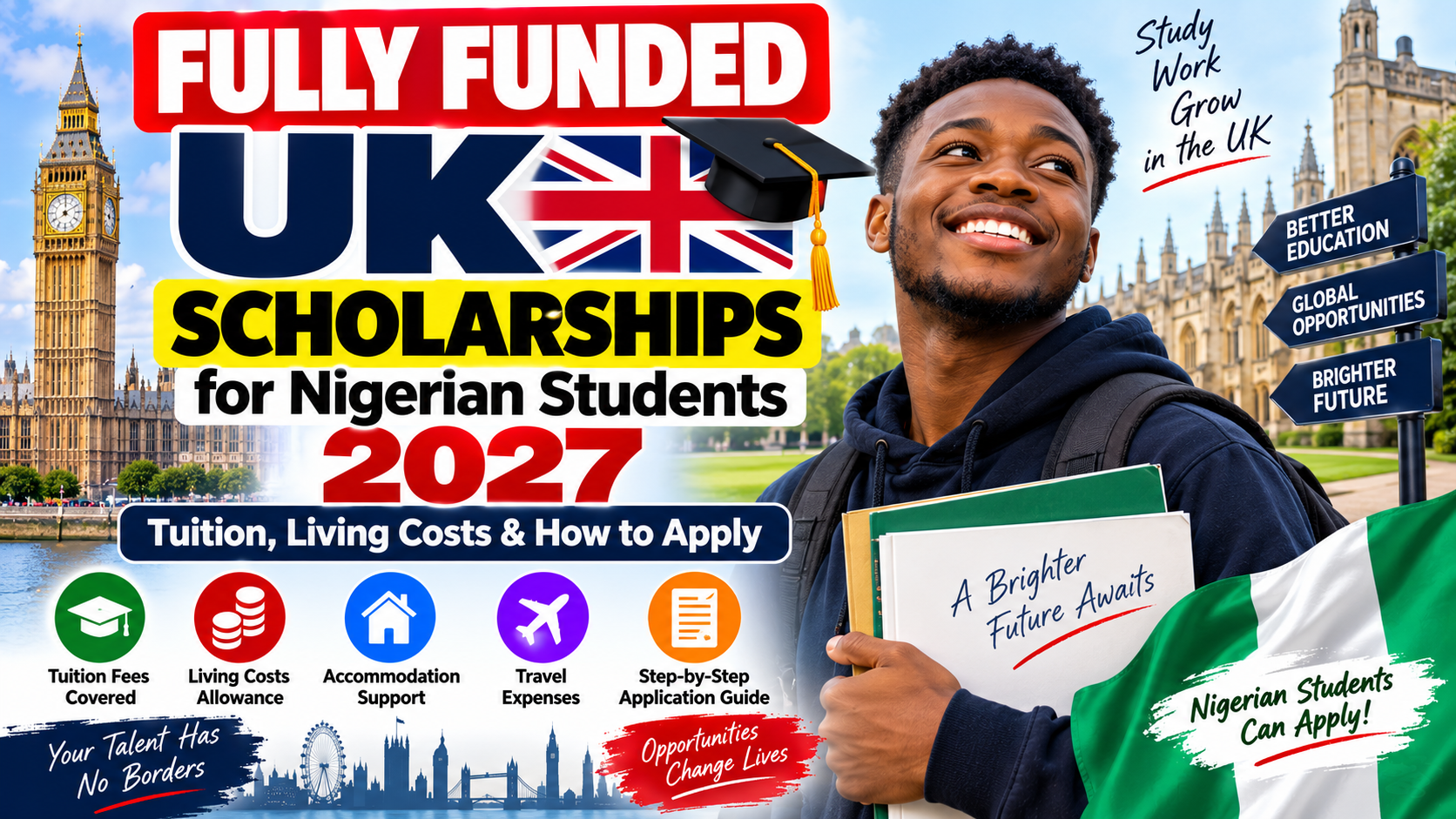
Studying in the UK in 2027 does not necessarily mean your family has to find millions of naira for tuition fees and living expenses. There are scholarships that can take care of most, and in some cases almost all, of the major costs involved.
For Nigerian students, the real challenge is usually finding these opportunities early enough and knowing which ones are genuinely fully funded. There is a big difference between a university offering a £3,000 tuition discount and a scholarship that pays your entire tuition, gives you money every month for living expenses and even helps with your flight to Britain.
If you are hoping to start a master’s or PhD in the UK in 2027, now is actually the right time to begin looking. This is because many scholarships for courses starting in September or October 2027 require applications several months earlier. Some applications are already taking place in 2026.
Below are some of the strongest opportunities Nigerian students should have on their list.
Chevening Scholarship
Chevening is probably the first scholarship many Nigerians hear about when they start looking for fully funded master’s opportunities in Britain, and there is a good reason for that.
It is a UK Government scholarship aimed at people who have shown potential to become leaders or make a difference in their field.
For the 2027/28 academic year, applications opened on 4 August 2026 and the deadline is 6 October 2026 at 11:00 UTC.
That date is worth paying attention to. If your plan is to enter a UK university in September or October 2027, you don’t wait until 2027 to start your Chevening application. The scholarship process begins almost a year before you actually arrive in Britain.
Chevening is mainly for a one-year taught master’s degree.
The attraction is not simply that your university fees can be paid. The award normally covers tuition and also provides a monthly allowance to help with your living costs while you are in Britain. There is support towards travelling to and from the UK, and the scholarship also covers the cost of one visa application alongside certain other allowances.
For somebody coming from Nigeria, that makes a huge difference.
Without funding, you are not only thinking about university fees. You have accommodation, food, transportation, your flight, visa-related expenses and the general cost of living in Britain to consider.
Chevening removes a large part of that financial pressure.
But getting it is competitive.
A mistake people sometimes make is assuming that a First Class degree alone will automatically put them ahead. Academic achievement certainly helps, but Chevening also wants to understand what you have actually done outside the classroom.
Your work experience, leadership, relationships you have built professionally and your plans for the future all matter.
When writing the application, saying something like “I am a hardworking person and a great leader” is not particularly convincing on its own.
A better application shows what happened.
Perhaps you noticed a problem at work, organised other people to solve it and achieved a particular result. Or you started a community project and can explain how many people benefited. Those examples tell the person reading your application much more about you than simply describing yourself as a leader.
You will also need to think carefully about the UK courses you choose.
Chevening applicants select three eligible courses. The courses do not have to be at the same university.
You don’t need to have every university offer in your hand before making the initial scholarship application. However, if you progress through the process, you will eventually need an unconditional offer from at least one eligible course.
For the current 2027/28 cycle, the deadline for meeting that university-offer requirement is 8 July 2027.
Commonwealth Master’s Scholarship
The Commonwealth Master’s Scholarship is another one Nigerian graduates should take seriously, particularly if the cost of studying in Britain would otherwise make a UK master’s impossible.
The scholarship is supported through the Commonwealth Scholarship Commission in the UK.
Nigeria is among the countries whose citizens can be eligible.
Applications for programmes beginning in the 2027/28 academic year opened on 8 September 2026. The current deadline is 20 October 2026 at 16:00 BST.
The financial support is substantial.
Approved tuition fees are covered.
There is also an approved return airfare between your home country and the UK.
Then there is money for living expenses.
At the rates currently published by the Commonwealth Scholarship Commission, the living allowance is £1,712 per month. If your university is within the London metropolitan area, that rises to £2,000 per month.
Think about what that means in practical terms.
Instead of receiving only a tuition waiver and then having to find money for rent and food yourself, you receive regular financial support while studying.
Depending on your circumstances, there can also be additional allowances.
There are academic requirements, of course.
For the 2027 scholarship, candidates would normally need at least an upper second-class degree, commonly called a 2:1 in the UK.
Someone with a 2:2 should not immediately assume there is no possibility, because the rules also make provision for certain applicants who have a lower second-class degree alongside a relevant postgraduate qualification.
Another important condition is financial need. The scholarship is intended for people who could not otherwise afford to study in the UK.
You should read the official application procedure carefully because Commonwealth applications can involve a nominating organisation in addition to the main scholarship application.
Don’t leave this until the final day.
University of Cambridge Mastercard Foundation Scholars Program
For African students, the Mastercard Foundation Scholars Program at the University of Cambridge is one of the opportunities worth looking at closely.
The 2027/28 application cycle is open.
This scholarship is aimed at talented young people from Africa who want to undertake postgraduate study at Cambridge and later contribute to their communities and the continent more widely.
The financial package is one of the reasons it stands out.
The programme covers the course fee and gives scholars a monthly maintenance allowance for their everyday living costs.
It also covers a return flight.
Successful scholars receive a laptop, and support is available for costs connected with the UK Student visa and Immigration Health Surcharge.
In other words, this is much closer to what most people imagine when they hear the words “fully funded.”
You still need to be academically strong enough to get into Cambridge.
The scholarship does not lower the academic requirements of your chosen degree. You have to qualify for the course first.
There are also rules around nationality and residence. Applicants should be citizens of an African country and would normally be living in Africa, although the programme explains certain exceptions on its website.
One thing applicants should not overlook is the scholarship statement.
This is where you need to connect your past with your future.
What have you already done? Why does this particular Cambridge degree make sense for you? What problem do you want to work on? What will you realistically do with the education afterwards?
Specific answers are much stronger than broad promises about “changing Africa.”
Cambridge also excludes some programmes from this particular scholarship. At the time of writing, these include the MBA, Master of Finance, Master of Corporate Law and Master of Accountancy.
Check your exact course before spending days preparing an application.
Oxford Clarendon Scholarship
If Oxford is your target, Clarendon should be one of the first funding options you investigate.
Oxford awards around 200 new Clarendon scholarships each year.
There is no restriction that prevents Nigerians from applying simply because of their nationality.
Clarendon can cover your course fees in full and provide financial support towards living expenses.
For comparison, Oxford states that the minimum annual living grant for a full-time Clarendon scholar in 2025/26 was £20,780. That does not mean the figure will be exactly £20,780 for somebody starting in 2027, because the amount can change. The university will publish the relevant figure for the applicable year.
There is another reason Clarendon is attractive: there normally isn’t a separate scholarship form to fill in.
You apply for your eligible Oxford graduate programme by the relevant December or January funding deadline and are automatically considered for Clarendon.
But don’t misunderstand the word “automatically.”
It means you are automatically considered for the scholarship. It does not mean the scholarship is automatically awarded.
Competition is extremely strong.
Academic performance plays a major role. Oxford says the majority of successful Clarendon scholars normally have at least the equivalent of a First Class degree.
References and the overall strength of your graduate application can also be important.
If you are serious about Oxford, don’t rush your application simply because there isn’t a second Clarendon form. Your Oxford admission application is effectively doing two jobs: asking the university for a place and putting you forward for funding consideration.
University of Edinburgh Mastercard Foundation Scholars Program
There is another Mastercard Foundation opportunity at the University of Edinburgh.
This one is particularly interesting because the 2027/28 application process has several stages, and missing one of the early stages can stop you from progressing.
For the current cycle, prospective applicants first have to attend a mandatory online information session.
The university scheduled these sessions between 15 and 24 September 2026.
People who meet the initial requirements can then move forward through the scholarship process.
Eligible attendees are expected to be informed on 13 October 2026 whether they have been invited to apply.
The next stage includes an Applicant Declaration Form, with a published deadline of 19 October 2026 at 5pm UK time. Edinburgh also warns that this stage could close earlier if it reaches its application limit.
The main scholarship application then has a deadline of 19 November 2026 at 5pm UK time.
The programme is aimed at African applicants with strong academic ability as well as evidence of leadership and service to their communities.
There is also a focus on the climate crisis. Applicants are expected to show experience or ambitions connected with addressing climate-related challenges.
Age is another important requirement.
For the 2027/28 intake, applicants must be 35 or younger in the year the programme starts. Edinburgh explains this as being born on or after 1 January 1992.
Master’s applicants should also not already have completed a postgraduate degree.
Read the university’s instructions carefully before applying for the academic course itself because Edinburgh’s Mastercard process works differently from some other scholarships.
Bartlett Promise Sub-Saharan Africa Master’s Scholarship at UCL
Students interested in subjects connected with the built environment should keep an eye on University College London’s Bartlett Promise Sub-Saharan Africa Master’s Scholarship.
This could include people interested in areas such as architecture, planning, construction, development, sustainability and related subjects offered by The Bartlett.
Nigeria is included among the eligible Sub-Saharan African countries.
The most recently published funding package gives a good idea of how valuable the scholarship can be.
For the 2026 cycle, it covered the full overseas tuition fee and included an allowance of £17,796 for living and study expenses.
There was also support for a flight to and from the UK, the UK Study Visa, Immigration Health Surcharge and certain other costs.
However, there is an important point for anyone reading this because they want to study in 2027.
The previous round is closed.
UCL says information about its 2027 application process will be published by the end of October 2026.
So don’t find an old deadline on another scholarship website and assume it applies to you.
Use the time before the announcement to look through Bartlett’s master’s programmes and decide which course actually fits your background.
What will a fully funded scholarship really pay for?
This is where students need to be careful.
The phrase “fully funded scholarship” gets used very loosely online.
You might see a Facebook post saying, “UK Fully Funded Scholarship 2027,” click through and discover that the university is actually offering £5,000 towards a £25,000 tuition fee.
That is useful funding, but it isn’t the same thing as having your entire study costs covered.
Before applying, look for five things: tuition fees, living allowance, airfare, visa costs and the Immigration Health Surcharge.
A scholarship doesn’t necessarily have to cover every single one of these to be worth applying for, but you need to know what you will still have to pay yourself.
If your tuition is covered but you have no maintenance funding, for example, you still need a realistic plan for rent, food and transportation.
Start getting your documents ready
One advantage of starting early is that you don’t have to prepare everything under pressure.
Get your academic documents together.
That normally means your degree certificate and transcript. Make sure the name and other information on your documents are correct.
Check your passport as well.
Then work on your CV.
A scholarship CV should be easy to read and should show what you have actually achieved rather than being filled with exaggerated descriptions.
You should also start thinking about references.
Choose people who genuinely know your academic or professional work.
A detailed reference from somebody who can explain your abilities is far more useful than simply choosing the most senior person you know.
Depending on your course, you may eventually need other documents such as a research proposal, writing sample or evidence of English ability.
Do Nigerian students need IELTS?
There isn’t one answer that applies to every British university.
Some Nigerian applicants can satisfy a university’s English-language requirement through previous education or other accepted evidence. Others may be asked to take IELTS or another approved English test.
The scholarship itself may also have different rules from the university.
Cambridge’s Mastercard Foundation guidance, for example, allows applicants to begin the application without already having an IELTS result. Where English-language evidence is subsequently required, it can form part of a conditional university offer.
So don’t spend money on an English test simply because somebody on social media says every Nigerian scholarship applicant needs IELTS.
Go to the admissions page for the exact course you want and check what that university accepts.
What if you graduated with a 2:2?
A 2:2 makes some of the scholarships discussed here more difficult or unavailable, but it does not mean you should abandon the idea of getting funding in the UK.
The important thing is to stop treating “UK scholarships” as though they all have one set of rules.
They don’t.
Oxford Clarendon is exceptionally competitive academically.
Commonwealth Master’s normally expects a 2:1, although its rules provide for certain applicants with a 2:2 plus an appropriate postgraduate qualification.
Other universities may have scholarships where professional experience, financial circumstances or other achievements carry significant weight.
Check the actual entry requirement instead of disqualifying yourself because of something you read in a Facebook comment.
Don’t wait until 2027
This may be the most important thing to understand.
A “2027 scholarship” does not necessarily mean applications open in 2027.
Many of the applications are made in 2026 because universities and scholarship organisations need months to assess applications, conduct interviews and complete admissions before students arrive for the new academic year.
Chevening’s current deadline is 6 October 2026.
The Commonwealth Master’s Scholarship deadline is 20 October 2026.
Edinburgh’s Mastercard Foundation process has important stages taking place between September and November 2026.
Oxford and Cambridge applicants also have to pay close attention to course funding deadlines around December and January.
Someone who waits until the middle of 2027 to begin searching could discover that several of the biggest opportunities have already closed.
Finally, be careful with anyone promising guaranteed scholarships.
You do not need to pay somebody thousands of naira to submit a Chevening application for you.
An agent cannot guarantee you Clarendon, Commonwealth or Mastercard Foundation funding.
Read the official information yourself. Give yourself enough time. Write your application in your own voice and make sure every achievement you mention is true.
A strong application does not need complicated English.
It needs to give the people assessing it a clear picture of who you are, what you have done, why you need the opportunity and what you intend to do with it.
For Nigerian students who genuinely cannot afford the cost of studying in Britain, these scholarships can turn an otherwise unrealistic plan into something possible. But the process starts long before you board a flight to the UK.
For students hoping to begin in 2027, that process is already underway.
Official websites and application links
Chevening Scholarship – Nigeria
https://www.chevening.org/scholarship/nigeria/
Chevening Application Timeline
https://www.chevening.org/scholarships/application-timeline/
Commonwealth Master’s Scholarships
https://cscuk.fcdo.gov.uk/scholarships/commonwealth-masters-scholarships/
Oxford Clarendon Scholarships
https://www.ox.ac.uk/admissions/graduate/fees-and-funding/funding/clarendon
Clarendon Information for Applicants
https://www.ox.ac.uk/admissions/graduate/fees-and-funding/funding/clarendon/applicants
University of Cambridge Mastercard Foundation Scholars Program
https://www.mastercardfoundation.fund.cam.ac.uk/
Cambridge Mastercard Foundation – How to Apply
https://www.mastercardfoundation.fund.cam.ac.uk/apply/how-apply
University of Edinburgh Mastercard Foundation Scholars Program
https://edinburgh-global.ed.ac.uk/mastercard-foundation-scholars-program
Edinburgh Mastercard Foundation – How to Apply
https://edinburgh-global.ed.ac.uk/mastercard-foundation-scholars-program/apply-for-a-scholarship/how-to-apply
UCL Bartlett Promise Sub-Saharan Africa Master’s Scholarship
https://www.ucl.ac.uk/bartlett/study/scholarships-and-funding/bartlett-promise-scholarship/bartlett-promise-sub-saharan-africa-masters-scholarship
